
- All
- Product Name
- Product Keyword
- Product Model
- Product Summary
- Product Description
- Multi Field Search
Views: 0 Author: Site Editor Publish Time: 2026-05-26 Origin: Site


Purchasing a non-motorized running machine represents a major capital investment. This holds true for both home gym owners and commercial facility operators. You need equipment delivering measurable fitness results. Buyers often confuse a standard manual treadmill for a fixed resistance machine. This confusion leads to misaligned fitness programming. It also wastes your valuable equipment budget.
We created this article to solve this exact problem. You will evaluate the specific biomechanical benefits of added resistance systems. We also cover the metabolic demands these machines place on users. You will get a clear "buy or pass" decision matrix. This framework relies on your specific training goals. We also factor in space constraints and budget realities. By the end, you will know exactly if this specific conditioning tool fits your floor plan.
Metabolic Demand: A curved treadmill requires up to 32% more oxygen and burns roughly 30% more calories than a motorized treadmill at the same perceived pace.
The Resistance Advantage: Fixed resistance models (utilizing magnetic or friction gearing) allow for functional training like sled push simulations, not just sprinting.
Ideal Profiles: Best suited for functional fitness athletes (HIIT/CrossFit), facility owners seeking zero-electricity overhead, and runners needing form correction.
Limitation: Not recommended for users seeking steady-state, low-effort cardio, or those requiring automated incline training.
Understanding equipment mechanics prevents costly purchasing mistakes. Standard manual treadmills and fixed resistance models look similar. However, they serve completely different athletic purposes. You must understand their underlying mechanics to program your workouts effectively.
A standard Curved Treadmill relies entirely on gravity and foot placement. You drive the slat belt by stepping higher up the front curve. This action uses your body weight to pull the treads downward and backward. The concave design naturally forces you into a mid-to-forefoot strike. You cannot rely on a motor to pull your legs backward. You must actively pull the belt backward yourself.
Resistance changes everything. A fixed resistance model integrates a manual lever connected to a magnetic or friction braking system. This system usually features six to eight specific gear levels. Level one feels like a standard free-spinning belt. The highest level locks the belt into a heavy, grinding track. You control this mechanical friction manually. It does not require a digital interface or electricity.
Dialing up the resistance completely changes your workout stimulus. You shift away from traditional cardiovascular sprinting. The heavy belt forces you into deep posterior chain strength training. Your glutes, hamstrings, and calves work aggressively. You engage in heavy drive-phase mechanics. The movement mimics pushing a heavy sled across turf. It builds raw leg power rather than just aerobic endurance.
You must respect the lack of motor assistance. New users often try to match their standard motorized treadmill speeds. This mistake leads to rapid burnout. You must manually scale your target pacing down by roughly 20%. The active muscle engagement requires significantly more energy. Accept the slower pace. Focus on the increased muscular effort instead.
| Feature | Motorized Treadmill | Standard Curved | Fixed Resistance Curved |
|---|---|---|---|
| Power Source | Electricity | Human Power | Human Power |
| Pace Control | Button/Automated | Self-Regulated | Self-Regulated |
| Resistance | None (Incline only) | None (Free spin) | Magnetic/Friction (6-8 Gears) |
| Primary Benefit | Steady-State Cardio | Sprint/Form Coaching | Strength & Sled Simulation |
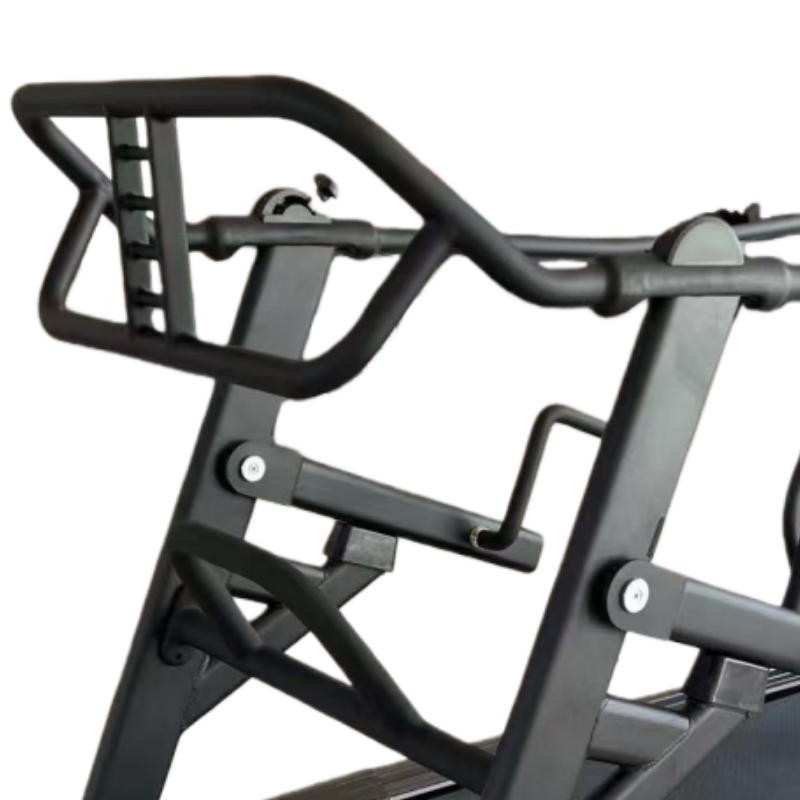
High-level athletes demand responsive equipment. Traditional machines often hinder explosive training. A Fixed Resistance Curved Treadmill solves these programming bottlenecks immediately. It caters specifically to the intense demands of functional fitness.
Motorized belts take precious seconds to reach sprint speeds. They also take time to slow down. This lag ruins true High-Intensity Interval Training (HIIT). An unmotorized belt eliminates this waiting period. The running surface accelerates instantly as you drive your legs. It decelerates exactly when you stop. This precision makes it the superior choice for aggressive sprint intervals. You dictate the exact work-to-rest ratios without fighting a machine.
You can treat this machine as a multi-tool. High resistance completely transforms the equipment. You do not need 20 yards of indoor turf to push a sled. You crank the resistance lever to the maximum setting. You lean forward into the handles. You drive the belt backward using pure leg power. This simulates a heavy indoor sled push perfectly. You can also simulate heavy farmer's carries. It provides functional strength training in a tiny footprint.
Sports medicine principles highlight the importance of self-regulated pacing. Outdoor running forces you to adjust your speed dynamically. You react to fatigue and terrain. Unmotorized belts mimic this reactive agility demand perfectly. You learn to control your body mechanics under duress. The machine does not enforce a rigid pace. You must generate the effort, improving both physical and mental resilience.
Facility owners face unique operational challenges. Space is expensive. Power outlets dictate layout designs. Equipment maintenance drains monthly budgets. Non-motorized treadmills offer compelling solutions to these logistical headaches.
These machines operate completely off-grid. They generate zero electricity overhead. You gain massive flexibility for facility placement. You can place them in the middle of a garage. You can line them up on a gym floor without running extension cords. You never have to worry about tripping breakers during a busy class. This freedom optimizes your available square footage.
Motorized machines break down frequently. Motors burn out. Motherboards fail due to sweat and dust. A fixed resistance model removes these fragile components. They utilize heavy-duty slat-belt systems. Manufacturers often rate these belts for up to 150,000 miles. They rely on simple ball bearings and sturdy rubber treads. This structural simplicity eradicates costly digital failures. You wipe them down, and they keep running.
Commercial gyms need engaging workout stations. These treadmills seamlessly integrate into functional training zones. They offer a high-throughput, low-maintenance station. Members cycle through sprints and sled pushes quickly. The unique, hard-working user experience stands out. Members feel a distinct muscle burn they cannot get from standard equipment. This differentiated programming directly enhances member retention. It proves your facility invests in serious training tools.
Many runners suffer from chronic joint pain. Traditional motorized belts often encourage lazy running mechanics. An unmotorized, concave belt acts as a strict physical therapist. It forces structural corrections naturally.
The concave shape actively penalizes overstriding. If you reach too far forward, you hit the steep upward curve. It feels awkward and halts your momentum. The machine acts as an active "running coach." It forces you into a highly efficient, high-cadence stride. You naturally adopt a forefoot or mid-foot strike. You keep your feet directly under your center of gravity. This positioning corrects years of poor running habits.
Standard electric belts pull your leg backward passively. This passive motion increases sheer stress on your knees. Unmotorized machines require active participation. You drive the belt using your posterior chain. You pull the treads backward with your hamstrings and glutes. This active muscular engagement absorbs shock. It significantly reduces the harsh braking forces traveling up to your lower back. Your muscles take the load, not your joints.
Biomechanical efficiency hinges on ground contact time. Heavy heel-strikers linger on the belt too long. The curved design naturally shortens your ground contact time. Your foot hits the belt, drives backward quickly, and cycles upward. This rapid turnover translates to safer rehabilitation. Injury-prone runners rebuild foundational strength safely. You learn to run lightly and quietly.
No single piece of equipment serves everyone. While highly effective, these machines present severe drawbacks for specific user profiles. You must recognize these limitations before purchasing.
Many users enjoy long, uninterrupted, low-effort runs. They want to jog gently while watching a screen. This machine will frustrate them deeply. The continuous physical demand remains extremely high. Your running economy drops significantly. You work roughly 38% harder to maintain the exact same speed. An easy three-mile jog feels like a grueling threshold workout. Steady-state cruisers will find it overly exhausting.
Some users train specifically for mountaineering or heavy hiking. They rely on high electronic inclines. They set their motorized decks to 15% or higher. An unmotorized belt does not offer a 1:1 substitute for this. You cannot elevate the deck. While the heavy resistance mimics a steep climb's muscular burn, the ankle angle remains flat. Incline seekers will miss the structural elevation changes.
We must acknowledge the high upfront acquisition cost. Quality slat belts and heavy steel frames cost money. Users looking for a basic walking pad face a steep price barrier. If you only want a sub-$500 entry-level machine to walk on during meetings, this is not for you. You will not see a sensible return on investment. The advanced mechanics exceed basic walking requirements.
You must evaluate specific hardware components carefully. Not all models deliver the same durability or resistance profiles. Use the following criteria to analyze potential vendors.
The running surface dictates your comfort and safety. You need enough room to sprint fully without fear of falling off.
Dimensions: We recommend a minimum running surface of 55 inches long by 18 inches wide. Shorter belts clip your natural stride.
Slat Quality: Look for thick, vulcanized rubber slats. Cheap plastic slats crack under heavy loads. Quality rubber absorbs shock efficiently.
Curvature Depth: Test the curve if possible. A curve that is too shallow feels unresponsive. A curve that is too steep exhausts your calves instantly.
The resistance system defines this specific machine category. You must verify its functional range.
Granularity: Check the number of levels. Six to eight levels provide excellent control.
Maximum Resistance: Ensure the heaviest gear provides true dead-stop resistance. You should be able to lean into the handles and drive hard without the belt slipping away easily.
Shifting Mechanism: The lever should snap into place clearly. Magnetic systems often provide smoother transitions than basic friction pads.
Heavy resistance training requires an immovable base. If the machine rocks, you lose power transfer.
Frame Construction: Demand heavy-gauge steel frames. Avoid models utilizing excessive plastic shrouds.
Weight Rating: Look for a minimum user weight capacity of 275 to 300+ lbs. High capacity indicates strong internal bearings.
Machine Weight: The treadmill itself should be heavy. A 350-pound machine stays planted during aggressive sled pushes.
Unmotorized machines lack complex screens, but tracking remains important for many athletes.
Basic Metrics: Ensure the LCD tracks time, distance, pace, and wattage accurately.
Digital Integration: Determine if you need Bluetooth or ANT+ connectivity. If you use apps like Zwift or Kinomap, verify compatibility before buying. Some basic monitors do not broadcast data.
| Feature Focus | Minimum Standard | Premium Standard |
|---|---|---|
| Running Area | 55" L x 18" W | 60"+ L x 20"+ W |
| Max User Weight | 275 lbs | 350 - 400 lbs |
| Resistance Gears | 3 to 4 Levels | 6 to 8 Levels (Magnetic) |
| Connectivity | Basic LCD (Battery) | Bluetooth / ANT+ Enabled |
A fixed resistance curved treadmill is not a passive cardio machine. It operates as a specialized strength and conditioning tool. It bridges the gap between aerobic endurance and anaerobic power. By forcing you to drive the belt mechanically, it protects your joints, fixes your gait, and spikes your metabolic rate.
Your next steps require honest self-assessment. First, evaluate your primary training modality. If you prefer high-intensity intervals, functional strength, or sled pushes, this machine fits perfectly. If you strictly want easy, steady-state jogs, look elsewhere. Second, measure your available floor space carefully. These heavy machines require a permanent home. Once you confirm your goals and space, you can move forward confidently to vendor comparisons.
A: Yes. You expend significantly more energy driving the belt yourself. Research shows users consume up to 32% more oxygen and burn roughly 30% more calories. Your perceived exertion rate will be much higher at your normal pacing speeds.
A: Yes. Walking on the lowest gear feels natural and encourages a good foot strike. Cranking up the resistance lever transforms the walk into an exceptionally challenging weighted ruck simulation. It builds incredible calf and glute strength at a walking pace.
A: No. They lack electrical motors and complex motherboards. This simple mechanical design eliminates the most common points of failure. Maintenance typically involves wiping down the rubber slats and occasionally checking the frictionless bearings.
A: No. They are completely 100% human-powered. They remain entirely grid-independent. The basic LCD consoles run on standard batteries. You can place the machine anywhere in your gym or garage without worrying about power outlet proximity.


