
- All
- Product Name
- Product Keyword
- Product Model
- Product Summary
- Product Description
- Multi Field Search
Views: 0 Author: Site Editor Publish Time: 2026-03-19 Origin: Site


Confusion often arises when facility planners compare indoor cycling options, because not every stationary bike serves the same purpose. A Commercial Upright Bike represents a specific category within cardio equipment, designed to balance accessibility, durability, and performance for multi-user environments. Understanding what type of bike it truly is—and how it differs from recumbent and spin models—helps gym owners and fitness operators make clearer decisions when building a reliable and appealing cardio lineup.
An upright bike belongs to the indoor cycling family but most closely resembles traditional outdoor cycling posture. The rider sits vertically, with the torso positioned above the hips and the pedals directly beneath the body. This riding position feels natural to most users because it mirrors everyday bicycle use.
Within the broader exercise bike classification, upright models sit between comfort-focused and performance-focused designs. They do not recline like recumbent bikes, nor do they demand the aggressive forward lean typical of spin bikes. Instead, they provide a balanced posture suitable for general cardio and leg conditioning.
The defining characteristics of an upright exercise bike include a seated vertical posture, compact structure, and intuitive pedaling motion. Users sit on an adjustable saddle and grip handlebars positioned slightly forward, allowing for a stable yet active stance.
Because the footprint is relatively compact, upright bikes fit efficiently into commercial gym layouts. They are commonly arranged in rows alongside treadmills and ellipticals, creating a cohesive cardio area.
The familiar riding feel is one of the key reasons upright bikes remain popular. New members typically recognize the motion immediately, which reduces hesitation and speeds up onboarding.
Compared to recumbent bikes, upright models require more active core engagement and posture control. The absence of a backrest encourages users to stabilize themselves, engaging abdominal and lower back muscles while pedaling.
Compared to spin bikes, upright bikes are generally less aggressive. Spin bikes often position riders in a forward-leaning stance that emphasizes high-intensity cycling sessions. Upright bikes, by contrast, offer adjustable resistance and controlled training programs suited to a broader user base.
This positioning between comfort and performance makes the upright format versatile for commercial environments where users vary widely in age, fitness level, and training goals.
The classification becomes clearer when comparing upright bikes directly with recumbent and spin models. Each type fulfills a different purpose within a commercial gym setting.
A recumbent bike features a reclined seat with back support and forward-positioned pedals. This setup reduces stress on the lower back and shifts emphasis toward comfort. While suitable for rehabilitation or low-intensity cardio, recumbent bikes typically involve less core activation.
In contrast, an upright bike encourages active posture. Users must maintain balance without a backrest, which promotes greater engagement of stabilizing muscles. For facilities seeking equipment that supports general conditioning rather than passive comfort, upright bikes provide a stronger training stimulus.
Spin bikes are often associated with studio-style cycling classes. They emphasize high resistance, out-of-saddle riding, and performance metrics tailored to intense training sessions.
An upright bike serves a broader function. It supports steady-state cardio, interval training, and moderate-intensity sessions without requiring specialized cycling technique. The integrated console and resistance controls are typically more user-friendly, making the bike approachable for first-time gym members.
Bike Type | Riding Position | Best For | Why a Gym Chooses It |
Upright Bike | Upright seated posture | General cardio, leg conditioning | Easy for most users to start |
Recumbent Bike | Reclined seated posture | Comfort-focused cardio | More back support |
Spin Bike | Forward-leaning ride | Intense cycling-style sessions | Higher-performance training |
This comparison highlights how the upright format occupies a balanced middle ground, supporting accessibility without sacrificing effectiveness.
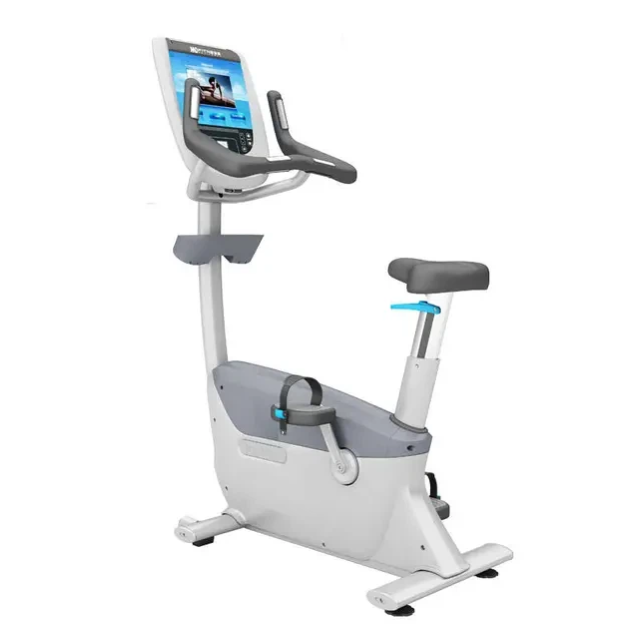
Not every upright exercise bike qualifies for commercial use. Commercial-grade models are engineered for durability, safety, and repeated daily operation in high-traffic facilities.
A commercial upright bike is constructed with reinforced steel frames, durable drive systems, and high-quality components capable of withstanding continuous usage. In public gyms, equipment may be used for many hours each day by members of varying body weights and training intensities.
Robust construction ensures stable performance over time. Resistance systems are designed for smooth transitions between levels, minimizing wear and preserving ride consistency. This reliability reduces downtime and supports long-term operational efficiency.
Commercial settings require fast adjustments between users. Seat height mechanisms must be simple and secure. Console interfaces must be intuitive so members can begin workouts without staff assistance.
Clear digital displays showing time, distance, calories, and resistance level enhance user experience. When equipment is easy to understand, members are more likely to use it regularly, increasing overall facility engagement.
For Shandong Obison Fitness Equipment Co., Ltd., producing commercial upright bikes means integrating durable engineering with user-friendly design, ensuring each unit performs consistently in demanding gym environments.
The upright bike excels in general cardio and lower-body conditioning. Its structure supports a wide range of workout styles without overwhelming new users.
Many gym members use upright bikes for steady-state cardio sessions at moderate resistance levels. The seated position allows users to maintain a controlled pace while elevating heart rate gradually.
Upright bikes are also popular as warm-up equipment before strength training. Pedaling at a light resistance prepares the lower body muscles and increases circulation without causing fatigue.
Because resistance can be adjusted easily, users can transition from light warm-ups to more challenging sessions without switching machines.
Pedaling resistance directly influences lower-body muscle activation. As resistance increases, the quadriceps, hamstrings, and glutes work harder to drive the pedals. Meanwhile, maintaining upright posture activates the core.
Unlike high-impact running, cycling minimizes joint stress while still providing effective cardiovascular stimulation. This makes upright bikes suitable for users seeking consistent training without excessive strain on knees and ankles.
Despite the growth of boutique cycling studios and specialized cardio machines, the upright format remains a staple in commercial gyms.
The familiar cycling motion reduces intimidation. Members who may hesitate to use complex equipment can quickly adapt to an upright bike.
For operators, this simplicity translates into smoother onboarding and fewer instructional demands on staff. Equipment that users can operate independently contributes to a more efficient facility environment.
Upright bikes typically require less space than some other cardio machines. Their vertical design allows multiple units to be placed side by side without overcrowding.
This space efficiency is particularly valuable in hotels, apartment fitness rooms, corporate gyms, and training studios where floor area is limited but versatility is essential.
A commercial upright bike is an ideal choice when a facility aims to provide inclusive, accessible cardio options. Gyms serving diverse populations benefit from equipment that accommodates beginners, intermediate users, and experienced athletes alike.
It is especially suitable when low-impact cardio must remain easy to access. For members recovering from high-impact sports or seeking alternative endurance training, upright cycling offers a practical solution.
Facilities building a balanced cardio lineup often include treadmills for running, ellipticals for full-body movement, and upright bikes for classic cycling. This combination covers multiple training preferences while maintaining consistency in user experience.
Manufacturers such as OBS FITNESS design upright bike models with durable construction, smooth resistance systems, and intuitive consoles, aligning commercial performance standards with everyday usability.
A Commercial Upright Bike is far more than a basic stationary bicycle. Positioned between comfort and performance, it delivers accessible, low-impact cardio while maintaining durability for high-traffic gym environments. Its familiar riding posture, efficient footprint, and adaptable resistance make it a reliable solution for public fitness facilities. For businesses seeking dependable cardio equipment to strengthen their lineup, a professional upright cycling machine offers both operational efficiency and user satisfaction. Contact us to learn more about commercial-grade cycling solutions developed by OBS FITNESS and discover how our equipment can support your facility’s growth.
A commercial upright bike is built for continuous multi-user environments. It features reinforced frames, durable components, and user-friendly consoles designed for high-frequency operation in gyms and fitness centers.
An upright exercise bike positions the rider vertically without back support, encouraging active posture and greater core engagement, while a recumbent bike provides a reclined seat focused on comfort.
Yes. The intuitive pedaling motion and adjustable resistance levels make it accessible to users of varying fitness levels, from beginners to advanced trainees.
It supports steady-state cardio, interval training, warm-ups, and lower-body conditioning, offering effective cardiovascular exercise in a low-impact format suitable for commercial gym environments.


