
- All
- Product Name
- Product Keyword
- Product Model
- Product Summary
- Product Description
- Multi Field Search
Views: 0 Author: Site Editor Publish Time: 2026-05-25 Origin: Site


The word "traction" often causes immediate semantic confusion. In clinical medical settings, it means passive spinal decompression. However, in modern strength and conditioning facilities, a vertical traction machine serves a highly distinct purpose. It operates as a dedicated piece of equipment for vertical pulling. You can think of it as a highly specialized lat pulldown variant. Clinical evidence on passive mechanical traction for non-specific back pain remains mixed today. Systematic reviews frequently show limited long-term efficacy for these passive stretching treatments. Conversely, active back strengthening stands as a universally accepted pillar of spine health. This guide evaluates how vertical traction machines support overall back health. They achieve this outcome through targeted, active muscular stabilization. We will objectively compare them to traditional free-weight alternatives. Finally, we provide a robust decision-stage framework. Facility operators and buyers sourcing commercial pin-loaded equipment will find this framework highly actionable.
Active vs. Passive: Commercial vertical traction machines improve back health actively by strengthening the latissimus dorsi, rhomboids, and traps, which stabilize the lumbar and thoracic spine.
Risk Mitigation: A high-quality Pin Loaded Machine provides a fixed, guided range of motion (ROM), significantly reducing the shear force on the lower back compared to free-weight alternatives like barbell rows.
Evaluation Criteria: Sourcing effective equipment requires evaluating biomechanical divergence, weight stack scalability, and adjustability to accommodate diverse user anatomies.
Clear Limitations: Vertical traction machines are strength tools, not medical devices; they are highly effective for preventative strengthening and muscular rehabilitation, but are contraindicated for acute spinal injuries (e.g., active disc herniations) without medical clearance.
Passive spinal traction often provides merely temporary physical relief. Medical devices like inversion tables expand the intervertebral space briefly. Clinical mechanical beds attempt to stretch the spine manually. They do not fix underlying muscular weaknesses. The medical community acknowledges this clinical limitation widely. Passive treatments fail to engage the surrounding support structures. Therefore, the pain often returns shortly after the session ends. You must look beyond passive stretching for long-term spinal health.
In contrast, the gym reality focuses heavily on active strengthening. A vertical traction machine demands strong, deliberate muscular engagement. You strengthen the back musculature actively during every repetition. This creates a natural "corset" around your entire torso. It effectively unloads the spine during harsh daily activities. Strong back muscles absorb shock efficiently. They prevent excessive wear on your intervertebral discs. Active stabilization builds resilience against future injuries.
The specific "vertical pull" offers a unique biomechanical benefit. Horizontal pulling exercises typically target mid-back thickness. They build the rhomboids and middle trapezius. Vertical pulling emphasizes your lower latissimus dorsi instead. It also creates a mild, active decompressive stretch. You feel this healthy stretch at the top of the movement. This mechanism promotes excellent shoulder mechanics naturally. It achieves this vital stretch without applying heavy axial loading. This keeps your cervical and lumbar spine perfectly safe.
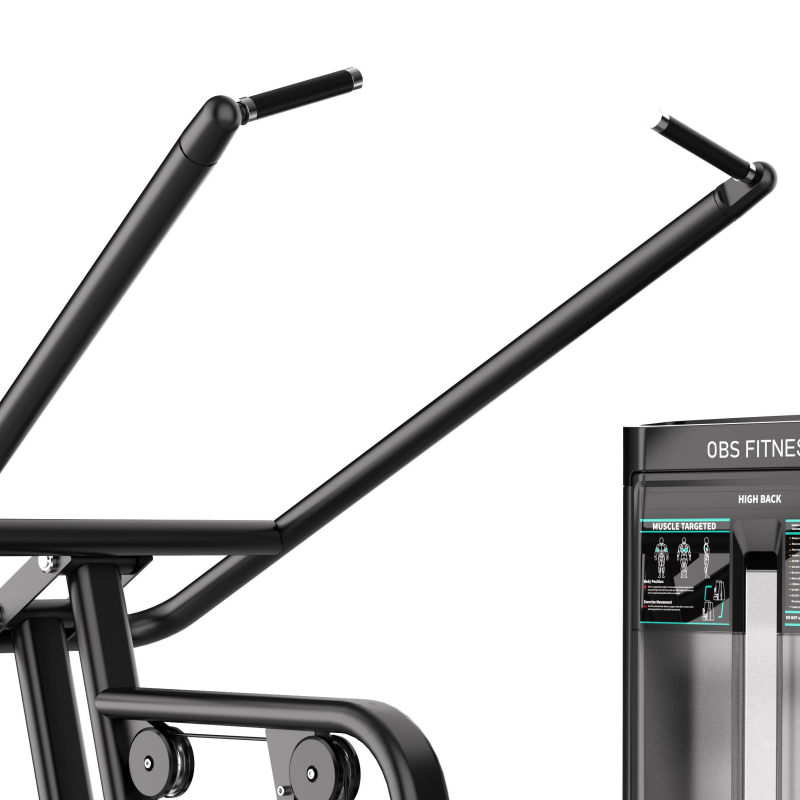
Many gym members have a documented history of back issues. Stabilizing free weights introduces dangerous micro-instabilities. Exercises like heavy dumbbell rows cause rapid core fatigue. This fatigue can easily trigger painful muscle spasms. A Pin Loaded Machine isolates the target muscles perfectly. It maintains strict external stability for the user at all times. You do not need to balance the weight manually. The machine guides the load through a perfectly fixed arc. This guided range of motion protects vulnerable joints.
Reducing lower back shear force remains critical for rehabilitation. Free-weight rows require your erector spinae to work constantly. They must support your heavy torso against gravity. This isometric burden exhausts the lower back prematurely. Seated vertical traction removes this isometric burden completely. Users can train their lats safely to muscular failure. They avoid risking lower back fatigue or severe injury entirely. The seated position anchors the pelvis securely. This anchoring prevents unwanted spinal rotation during the lift.
Standardized progression is another major therapeutic advantage. The selectorized nature allows precise, measurable weight increases. You can adjust the load seamlessly in micro-increments. This specific feature proves critical for physical therapy step-down programs. Patients moving from clinical rehab to general fitness need predictability. It also supports structured hypertrophy protocols safely. Users simply move the pin to increase resistance. They do not risk dropping heavy plates on themselves. The entire progression model becomes smooth and trackable.
You must evaluate specific biomechanical features carefully. Look for machines offering independent, diverging arm movements. This mechanism mimics the natural biomechanics of human shoulder joints perfectly. It prevents painful impingement during heavy lifts. It also allows a deeper, safer contraction of the lower lats. Fixed straight bars often force the wrists into awkward angles. Diverging axes solve this anatomical problem seamlessly.
Adjustability and ergonomics matter immensely for commercial facilities. Thigh-pad restraints must accommodate a very wide spectrum of heights. Seat height adjustability is equally vital for proper anchoring. Improper anchoring inevitably leads to momentum-based lifting. This sloppy execution compromises proper spinal alignment immediately. Users will lean back too far to compensate. Well-designed machines lock the user into an upright posture effortlessly.
Build quality directly impacts both safety and facility operations. Evaluating the operational smoothness is vital for gym owners. We recommend inspecting the internal pulley mechanism thoroughly. High-quality systems utilize premium precision bearings. They rely on high-tensile steel cables for fluid motion. For example, the OBS-BF Series Pin Loaded Machine eliminates dangerous "jerky" movements. Smooth mechanical action prevents shocking recovering muscles mid-lift. It delivers a premium feel across all weight increments.
To assist your evaluation process, we provide this comprehensive equipment chart below:
| Feature Category | Traditional Cable Pulldown | Modern Vertical Traction Machine |
|---|---|---|
| Arm Mechanics | Single straight bar (dependent motion) | Independent diverging arms |
| Spinal Stability | Moderate (relies on user core strength) | High (chest pad and fixed arc) |
| Shoulder Impingement Risk | Medium (fixed wrist angle) | Low (natural rotational arc) |
| Lower Lat Isolation | Good | Excellent |
You can clearly see the advantages of specialized equipment. Let us break down the specific mechanical traits further.
Precision Bearings: Reduce friction, preventing sudden weight drops.
Contoured Chest Pads: Prevent lumbar hyperextension during heavy pulls.
Gas-Assisted Seats: Allow quick adjustments between varying user heights.
Textured Grips: Reduce forearm fatigue, isolating the back muscles better.
Commercial facilities need reliable, specialized strength equipment today. Positioning the OBS-BF21 Vertical Traction Machine makes strategic sense here. It serves as a prime example for decision-stage shortlisting. Commercial gyms and high-end rehab facilities benefit greatly from its inclusion. This specific model bridges the gap between raw strength and clinical safety. It offers an exceptionally smooth pulling experience. Fitness directors highly favor its intuitive design.
Its biomechanical alignment stands out clearly against competitors. The specific arc of motion aligns optimally with human anatomy. It matches the latissimus dorsi fibers better than straight-bar lat pulldowns. This specific trajectory optimizes muscle recruitment significantly. It achieves this without straining the cervical or lumbar spine. The independent arms ensure balanced strength development. Users cannot compensate for a weak side using their dominant arm. This symmetrical training proves essential for structural spinal health.
Let us briefly analyze the overall facility footprint. Pin-loaded systems require minimal floor supervision generally. Plate-loaded or free-weight zones demand constant staff monitoring. Lower supervision reduces potential physical liability for facility owners. This machine caters simultaneously to novice users and advanced athletes. It offers exceptional frame durability under heavy commercial use. The fully enclosed weight stack adds an extra layer of safety. This makes it an ideal cornerstone for any modern selectorized strength zone.
| Muscle Group Assessed | Activation Level | Health Benefit for Spine |
|---|---|---|
| Latissimus Dorsi (Lower) | Very High | Provides global stabilization to the thoracolumbar fascia. |
| Rhomboids & Mid Traps | High | Retracts scapula, preventing rounded-shoulder posture. |
| Erector Spinae | Low (Isometric) | Rests safely while other muscles work, preventing spasms. |
Any exercise equipment carries inherent implementation risks. The primary adoption risk remains straightforward user error. Many people lean too far backward during the downward pull. This error turns the movement into a pseudo-horizontal row. It defeats the vertical traction purpose completely. Others rely heavily on unsafe, jerky momentum. Training cues should heavily emphasize keeping the torso completely upright. You must focus on pulling downward using your elbows strictly. Think about driving your elbows into your back pockets.
We must clearly define strict medical contraindications next. Certain individuals should avoid loaded vertical pulling entirely. You must wait for medical clearance if you suffer acute radiculopathy. Active sciatica symptoms can flare up under improper loading. Severe osteoporosis patients require professional guidance first. Unhealed spinal fractures demand complete physical rest. Only resume strength training when formally cleared by a licensed physical therapist. The machine is a preventative tool, not a diagnostic medical device.
Facility rollout requires strategic, thoughtful planning. Gym operators must integrate this equipment smoothly. Follow these structured best practices for successful integration:
Place the machine deliberately in the dedicated selectorized strength zone.
Keep it far away from chaotic, high-traffic functional training areas.
Ensure clear, visual instructional placards remain highly visible to users.
Train floor staff to spot and correct momentum-based lifting immediately.
Establish routine maintenance checks for cable tension and bearing lubrication.
Following these simple protocols ensures maximum user safety. It also extends the lifespan of your commercial equipment significantly. Education always remains your best defense against gym injuries.
A vertical traction machine represents an exceptionally helpful fitness tool. It promotes long-term back health highly effectively. You must understand it precisely as an active stabilization device. It does not replace passive medical decompression therapies prescribed by doctors. Instead, it builds the muscular armor necessary to protect your spine. The guided motion removes dangerous shear forces entirely.
Procurement managers should prioritize modern selectorized models immediately. Fitness directors need independent arm mechanics for their facility members. These specific features ensure maximum safety and broader accessibility. They cater to rehab patients and bodybuilders equally well. Upgrade your strength zones using biomechanically sound equipment today. Prioritize machines offering strict, guided stability to protect your members effectively.
A: They share the same "vertical pull" movement pattern. However, vertical traction machines often feature independent arms. They utilize a fixed, slightly angled arc of motion. This design offers more stability. It provides a much safer learning curve for those with lower back concerns than a traditional cable lat pulldown.
A: It cannot "cure" severe structural issues like a herniated disc. However, by strengthening the lats and improving posture, it addresses muscular weaknesses. These weaknesses are very often the root cause of chronic, non-specific lower back pain.
A: This is a very common user error. To protect the back and target the correct muscles, you must initiate the pull properly. Start by depressing your scapula (shoulder blades). Drive the elbows straight down. Do not simply pull down using your biceps.


