
- All
- Product Name
- Product Keyword
- Product Model
- Product Summary
- Product Description
- Multi Field Search
Views: 0 Author: Site Editor Publish Time: 2026-04-28 Origin: Site


Walk into any modern commercial gym or elite home setup today. You will quickly notice the rising popularity of non-motorized treadmills. As runners stare at these sleek, motorless belts, a natural skepticism arises. Can these machines truly replace traditional roadwork?
Traditional motorized treadmills enforce pacing automatically. You just keep up. In contrast, self-propelled belts demand constant physical input. When you introduce heavy friction gears into the mix, the equipment evolves. It changes from a pure cardio machine into a demanding hybrid strength-conditioning tool. The main challenge is determining if this premium investment actually aligns with your specific running goals.
In this comprehensive guide, you will learn how an Adjustable Resistance Curved Treadmill functions. It is a highly effective supplementary tool for form correction, interval training, and posterior chain activation. You will also understand exactly why it is not a direct replacement for your long slow distance (LSD) running days.
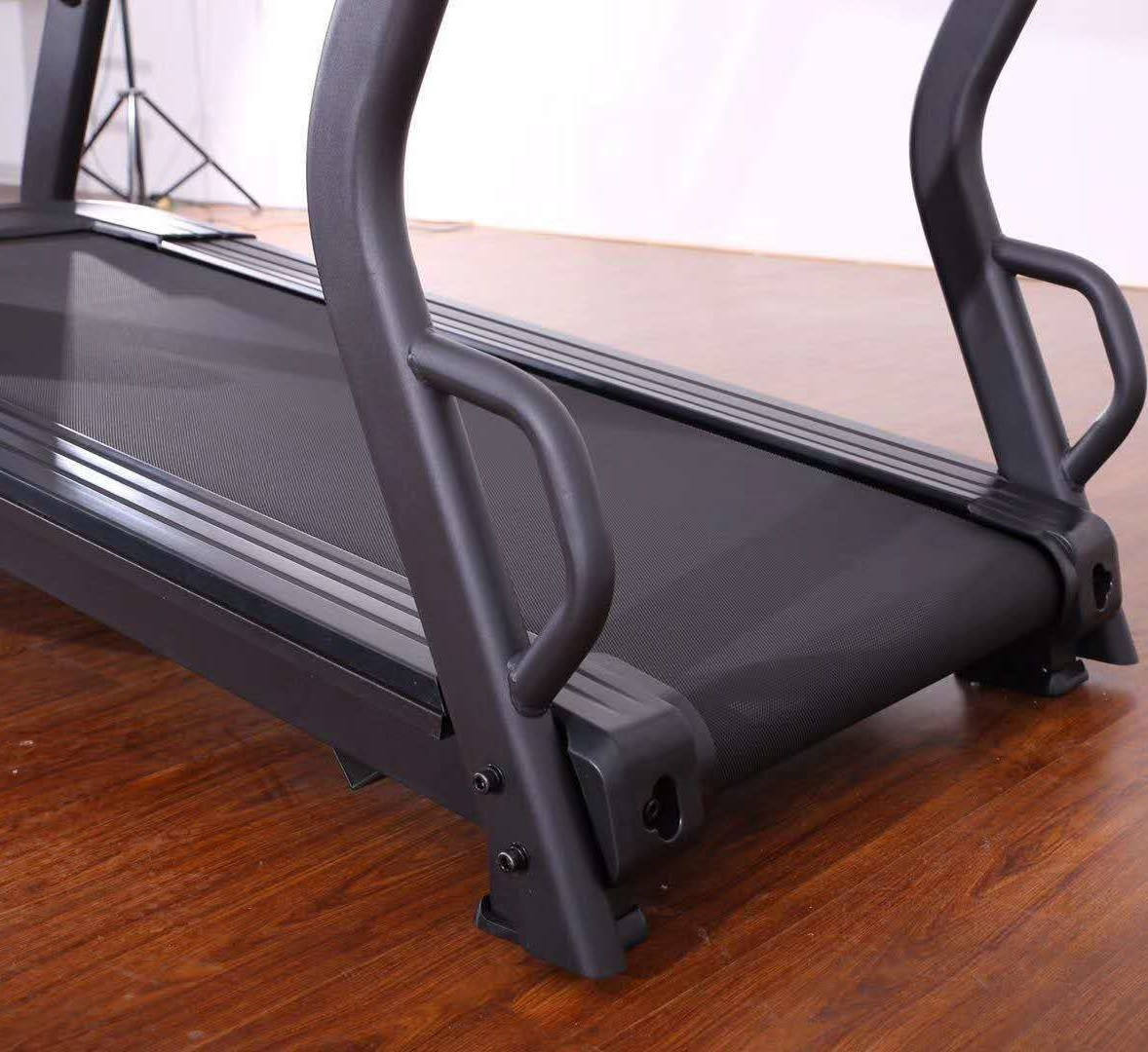
Higher Physiological Cost: Self-propulsion increases cardiometabolic demand, burning roughly 25-30% more calories and elevating VO2 max compared to motorized alternatives.
Built-in Form Correction: The curved deck acts as a real-time running posture check, naturally discouraging overstriding and promoting mid-foot/forefoot strikes.
The Resistance Factor: Adjustable resistance gears transform the treadmill into a sled-push simulator, ideal for building lower-body power and hill-climbing strength.
Not for "Zoning Out": Maintaining pace requires intense mental focus, making it suboptimal for long marathon-prep runs where runners want to disengage.
A conventional treadmill pulls your foot backward automatically. You essentially jump straight up and switch your legs in the air. A Curved Treadmill operates fundamentally differently. Gravity and friction force you to actively pull the heavy belt backward. You must dig in and drive through your hips. This physical requirement heavily recruits your glutes and hamstrings. You are no longer just lifting your knees. You are executing powerful hip extensions with every single stride.
You work considerably harder on a motorless belt. Sports science research consistently highlights a dramatic metabolic shift. Running at a constant speed on a curved deck increases your physiological load by up to 30%. Your heart rate spikes faster. Your oxygen uptake (VO2 max) increases rapidly. Consequently, you should expect noticeably slower paces for the same perceived exertion. A nine-minute mile outdoors might feel like a seven-minute mile on this deck.
The physical curve of the running surface alters your biomechanics immediately. It naturally curtails your stride length. You physically cannot reach your foot too far forward without feeling off-balance. This built-in limitation prevents severe overstriding. It encourages a natural mid-foot or forefoot strike. Ultimately, this reduces the heavy, jarring heel-strike impact commonly seen on flat, motorized belts.
Best Practices for Biomechanical Adaptation
Keep your head up and look straight ahead, not down at your feet.
Drive your elbows straight back to engage your core.
Focus on a quick cadence rather than taking long, reaching steps.
You must understand the hardware differences before buying. A standard free-spinning model relies entirely on your body position to dictate speed. It spins freely. An adjustable model includes magnetic or friction resistance levers. You can crank up the tension physically stopping the belt from rolling easily. This single lever completely changes your workout possibilities.
Feature | Standard Free-Spinning Belt | Adjustable Resistance Belt |
|---|---|---|
Primary Use | Speed work, tempo runs, aerobic conditioning. | Power development, sled pushes, hybrid training. |
Belt Tension | Loose, highly reactive to body position. | Variable, ranges from free-spin to complete lock. |
Muscular Focus | Calves, hamstrings, cardiovascular system. | Glutes, quads, heavy lower-body power. |
Traditional motorized machines tilt upward to simulate hills. Resistance levers simulate hills through sheer tension. Dialing up the resistance mimics steep inclines or heavy sled pushes. You must lean aggressively into the belt and drive with your quads. This allows runners to build explosive first-step quickness. You develop massive lower-body strength safely without needing barbells or heavy weights. It provides intense anaerobic conditioning in a highly controlled environment.
Interval training thrives on instant pace changes. Motorized belts take agonizing seconds to spool up to sprint speeds. A motorless belt reacts instantly. You can sprint at maximum velocity, then drop into a slow walk immediately. By manipulating the tension lever, you can switch from zero-resistance speed sprints to heavy-resistance power walks in one second. This adaptability makes it a highly efficient tool for blending aerobic and anaerobic workouts.
HIIT & Short-Distance Runners: You experience zero lag during speed changes. This makes the machine perfect for brutal 30-second all-out sprints. You dictate the exact acceleration curve.
Runners Rehabbing Posture: You might suffer from knee or hip pain due to overstriding. The natural shock-absorbing rubber slat belts reduce shear forces. The deck curve forces you to fix your posture immediately.
Athletes Seeking Hybrid Training: You might want to combine cardiovascular endurance with resistance-based leg conditioning. The adjustable brake turns your run into a functional strength circuit.
Endurance/Marathon Runners: Running long distances (e.g., 10+ miles) on a curve is grueling. It requires exhausting mental focus to maintain a steady, unvarying pace. You cannot simply "zone out" or watch television safely. Your pace will drift the moment your attention wanes.
Pure Sprint Competitors: Track athletes need to practice starting mechanics from blocks. The initial static friction of these heavy rubber belts prevents true block-start acceleration practice. It is excellent for top-end speed mechanics, but poor for the initial 10-meter explosion.
Common Mistakes to Avoid
Attempting a 10-mile recovery run during your first week.
Holding onto the handrails while running at top speed.
Leaning too far forward from the waist instead of hinging from the ankles.
Beginners often panic during their first session. You step onto the curve and the belt slips backward. You immediately feel a terrifying "loss of control." This is a standard illusion. You must master the learning curve of using your own body mass. You lean your center of gravity forward to accelerate. You stand tall and strike the center of the belt to brake. You control the machine entirely; it never controls you. Trust the physics of your body weight.
Community forums often debate joint health regarding these machines. The reality requires nuance. The thick rubber slat design offers superior shock absorption. The surface is often much softer than outdoor concrete or asphalt. However, the altered biomechanics introduce a different type of stress. You strike on your mid-foot. You actively pull the belt. This can cause temporary Achilles or calf fatigue for unconditioned runners. You trade knee impact for lower-leg muscular exertion. You must build this specific muscle endurance gradually.
Do not expect to crush your personal records on day one. Establish realistic goals. Your first three to five sessions will feel awkward. Your paces will be noticeably slower than your outdoor baseline. Your heart rate will climb faster. This is entirely normal. It represents a biomechanical adjustment, not a sudden loss of cardiovascular fitness. Your body is simply learning a new neuromuscular skill.
Not all curves are identical. The angle of the slope dictates the running experience. Shallower curves (measuring around 2.5 inches of drop) translate much more accurately to outdoor road running mechanics. Deep curves feel like running inside a hamster wheel. A deeper slope forces a more exaggerated, less natural gait. However, deeper curves often allow athletes to reach higher top speeds during maximum effort sprints.
The entire machine relies on internal ball bearings. Bearings dictate the smoothness of your ride. They dictate the noise level of the gym. High-quality sealed bearings provide a seamless, fluid glide. Cheaper models suffer from severe belt stutter. A stuttering belt ruins your running rhythm and creates excessive noise. Always evaluate the bearing specifications before purchasing.
Prepare your home gym space carefully. Non-motorized treadmills are exceptionally heavy. They are bulky, often measuring five to six feet in length. They completely lack folding mechanisms. You cannot tuck them under a bed or hide them in a closet. They require a dedicated, permanent space with a solid floor underneath. Ensure you have the square footage required before ordering.
These belts take a massive physical beating. The machine relies on physical friction and heavy slat impacts. A strong steel frame is standard, but the moving parts matter more. Prioritize brands offering multi-year warranties specifically on the rubber belt and the bearing assemblies. The frame warranty is less important than the warranty on the high-friction components.
Evaluation Checklist Summary
Measure your available floor space (Length, Width, Height clearance).
Identify the exact drop depth of the curve (Shallow vs Deep).
Verify the warranty length for bearings and rubber slats.
Check the maximum user weight capacity.
An adjustable resistance curved deck is a premium, high-yield investment. It serves runners intensely focused on improving form, maximizing workout efficiency, and generating lower-body power. The unique biomechanical demands enforce proper mid-foot striking and heavily recruit your posterior chain.
You should treat this equipment as a strategic, high-intensity supplement to your outdoor roadwork. It is not a complete replacement for your training regimen. Use it for blistering interval sessions, heavy sled-push simulations, and posture correction drills. Avoid it for long, mentally relaxing endurance runs.
For your next steps, strictly assess your home gym space constraints. Find a local commercial facility to test one in person. Evaluate your personal tolerance for the steep learning curve. Once you master the mechanics, this tool will elevate your running power to new heights.
A: Generally, no. The thick rubber slat belt absorbs shock significantly better than concrete or asphalt. Furthermore, the physical curve naturally encourages a mid-foot strike. This shift in biomechanics redirects impact forces away from your knee joints and distributes them safely into the muscles of your lower legs and calves.
A: You can, but it is not recommended. The mental focus required to maintain a steady pace is immense. If you lose focus, your speed drops immediately. Combined with the higher physiological tax of powering the belt yourself, it becomes mentally and physically exhausting for standard long slow distance (LSD) runs.
A: You are actively powering a heavy rubber belt with your own biomechanics. You have to overcome static friction with every step, which requires up to 30% more physical energy than road running. Seeing a significantly slower pace at an equal or higher heart rate is completely normal.


