
- All
- Product Name
- Product Keyword
- Product Model
- Product Summary
- Product Description
- Multi Field Search
Views: 0 Author: Site Editor Publish Time: 2026-07-12 Origin: Site


The increasing presence of non-motorized cardio equipment in both commercial facilities and premium home setups has complicated the standard treadmill purchasing decision. Buyers must weigh the higher upfront cost and learning curve of a curved treadmill against the ongoing maintenance, power requirements, and fixed-pace limitations of traditional motorized models. This evaluation breaks down the biomechanical differences, operational sustainability, and specific use-case suitability to determine which machine aligns with your specific training protocols and facility constraints. Facility owners and athletes need clear, field-tested data to make informed equipment selections that maximize floor space and support targeted athletic outcomes.
Metabolic Demand: Curved treadmills require the user to power the belt, resulting in a higher physiological demand and up to a 30% increase in caloric expenditure compared to motorized equivalents at the same speed.
Maintenance & Lifespan: Operating as a manual treadmill with no internal motor or complex electrical boards, curved models typically offer a lower long-term maintenance burden, resulting in superior commercial uptime.
Training Specificity: Traditional treadmills excel at controlled, steady-state endurance running, whereas curved models are biomechanically optimized for HIIT cardio, sprint training, and self-regulated pacing.
Facility Footprint & Acoustics: Curved models are significantly heavier, bulkier, and produce a distinct mechanical sound signature compared to the consistent hum of motorized gym cardio equipment.
Understanding the baseline mechanical differences helps evaluate how each machine dictates user movement and facility power requirements. The propulsion method fundamentally alters the running experience and the infrastructure needed to support the equipment on the gym floor.
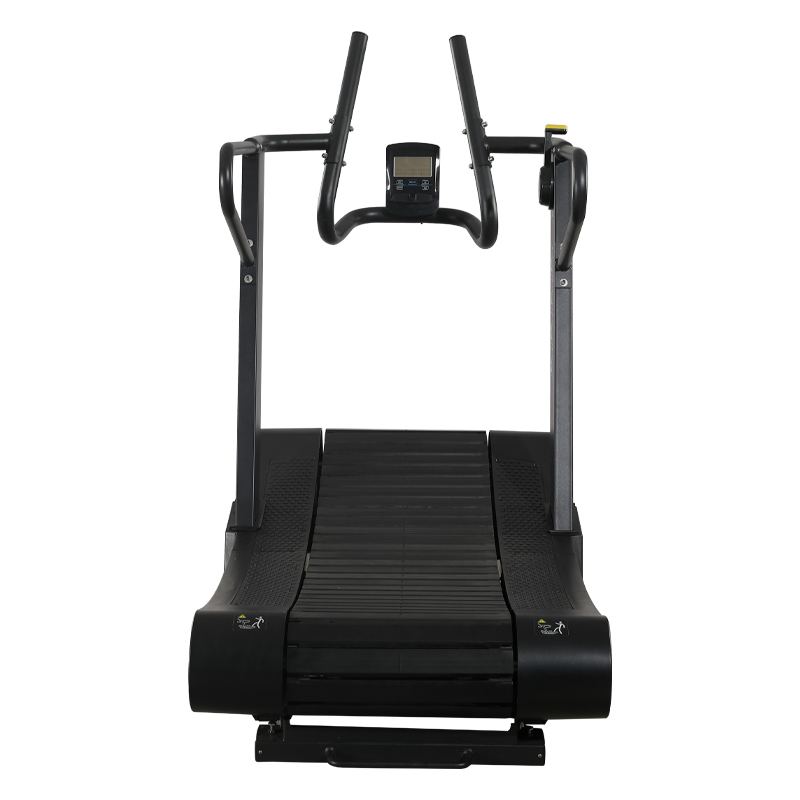
A manual treadmill utilizes a slat-belt design operating on a concave running surface. Gravity and the user's footstrike propel the belt backward. When a runner strikes the front curve of the deck, their body weight and forward momentum drive the heavy rubber slats down and back across precision ball bearings. There is no maximum speed limit. The pace is dictated entirely by the user's biomechanical output and physical exertion. This mechanical reality means the machine responds instantly to changes in stride length and cadence.
The internal components consist primarily of heavy-duty steel bearings, a reinforced frame, and vulcanized rubber slats. This simplicity removes the need for complex control boards. The user acts as the motor. When you drive your foot down, the belt moves. When you stop driving, the friction of the system naturally brings the belt to a halt. This direct feedback loop creates a highly responsive training environment.
Traditional motorized treadmills rely on a continuous-duty horsepower (CHP) motor system to pull a flat PVC or nylon belt over a solid deck. The machine dictates the pace, forcing the user to keep up with the automated speed. These units also feature motorized incline and decline adjustments, allowing runners to simulate hill climbs at the push of a button. This design requires a constant external power source, dictating where the equipment can be placed within a facility layout.
Motorized units rely on a complex interplay of drive belts, rollers, and electronic speed controllers. The motor must overcome the friction of the user's weight pressing the running belt against the deck. This constant friction generates heat and wear over time. Facility managers must account for dedicated electrical circuits to prevent tripped breakers during peak usage hours.
The ambient noise generated by these two systems differs drastically. A motorized treadmill produces a high-speed motor hum combined with the friction of the flat belt sliding over the deck. In contrast, a curved model produces a distinct mechanical sound as the heavy rubber slats slide over the internal bearing system. While curved models lack motor noise, their physical impact sound at high speeds can be significant.
In a commercial setting, a row of motorized treadmills creates a steady, white-noise drone. A row of curved treadmills during a sprint class generates a rhythmic, heavy clattering sound. Facility designers must consider these acoustic profiles when placing equipment near yoga studios or massage therapy rooms.
Comparing how each machine alters gait, muscle recruitment, and overall workout efficiency reveals why different athletes prefer different platforms. The mechanical design directly influences the physiological response to the exercise.
The claim that a curved model burns up to 30% more calories is rooted in physiological reality. Overcoming the initial friction of the heavy slat-belt and maintaining momentum requires continuous muscular engagement. The user is not just lifting their feet; they are actively driving the belt backward. This increased cardiovascular demand elevates the metabolic cost of the workout significantly compared to running on a motorized belt at the exact same speed.
Heart rate data consistently shows higher beats per minute (BPM) on a curved deck at equivalent perceived speeds. The body must recruit more muscle fibers to sustain the movement. This makes the curved deck highly efficient for athletes looking to maximize energy expenditure in shorter training windows.
The concave surface naturally encourages a mid-foot to forefoot strike. This foot placement reduces the impact forces transmitted through the knees and hips, promoting a more efficient running posture. Powering the belt demands heavy posterior chain engagement. The glutes and hamstrings must fire forcefully to pull the belt backward.
Conversely, running on a motorized flat belt tends to be slightly more quad-dominant. The machine assists in pulling the leg backward, altering natural overground running mechanics. Runners on motorized decks often develop a slight overstride, landing heavily on their heels because the moving belt pulls their foot away after contact.
Curved models excel at acceleration and deceleration dynamics, making them ideal for HIIT cardio. The user can go from a walk to a full sprint instantly, without waiting for a motor to spool up. Traditional treadmills lag in sprint training due to this motor transition time and the inherent safety risks of jumping onto a belt that is already moving at top speed.
The instant-on, instant-off nature of manual models allows athletes to transition rapidly between weightlifting and high-intensity running during circuit training. You can sprint for twenty seconds, step off safely, perform kettlebell swings, and step right back onto a stationary belt for the next round.
A standardized test protocol helps buyers and trainers experience the metabolic and biomechanical differences firsthand before committing to a specific equipment type. Run this test on both machines to gather comparative data.
Warm-up: 5 minutes of self-paced walking or light jogging to establish the baseline feel of the slat-belt versus the motorized belt.
Interval Block: 10 rounds of 30-second sprints followed by 30-second passive recovery. On the curved deck, focus on immediate acceleration and natural deceleration. On the traditional deck, focus on managing the motor transition lag and safety clip.
Cool-down: 5 minutes of steady-state recovery walking.
During this benchmark, track Peak Heart Rate, Rate of Perceived Exertion (RPE), and total caloric estimation across both trials. Users typically find that achieving their peak heart rate happens much faster on the curved deck. The perceived exertion is notably higher, contextualizing the increased metabolic demand of self-propulsion.
Record the time it takes to reach your target sprint speed. On the curved deck, this should take two to three strides. On the motorized deck, you must factor in the seconds it takes for the motor to ramp up to the programmed speed setting.
Assessing the logistical, spatial, and operational realities of integrating these machines into a gym space is necessary for facility managers and home gym builders. Equipment selection impacts floor plans and long-term operational expenses.
Commercial curved models are heavily overbuilt, often exceeding 350 lbs due to the steel frame and heavy rubber slats. They are bulky and rarely fold. Traditional treadmills, especially home models, offer folding mechanisms and lighter footprints. The immense weight of curved decks impacts moving logistics, floor load capacities, and the overall density of gym layouts.
When planning a facility layout, you must account for the clearance space required around each machine. Curved decks require less rear clearance because the user controls the stop, reducing the risk of being thrown off the back of a moving belt.
Traditional treadmills possess multiple failure points, including motor burnout, belt tracking misalignment, and control board electrical failures. Manual models offer mechanical simplicity. Maintenance generally involves periodic bearing lubrication or replacement and checking slat tension. The absence of complex electronics and motors translates to superior durability and fewer out-of-order signs on the gym floor.
A standard maintenance schedule for a motorized unit involves vacuuming the motor shroud, lubricating the deck, and calibrating the speed sensors. A curved deck primarily requires wiping down the handrails and occasionally inspecting the bearing tracks for dust accumulation.
Non-motorized equipment presents a highly eco-friendly profile. They require zero electrical power, reducing the facility's carbon footprint and utility draw. Over a standard 10-year lifecycle, the mechanical nature of these machines also results in a significantly reduced volume of electronic waste compared to motorized units that frequently require console or motor replacements.
Facilities aiming for green certifications benefit greatly from deploying self-powered gym cardio equipment. Removing the electrical draw of ten or twenty treadmills makes a measurable impact on monthly utility overhead.
Addressing the practical challenges users face when transitioning between equipment types ensures safer operations and better member retention. Proper onboarding mitigates injury risks and improves the user experience.
First-time users often experience balance, coordination, and pacing difficulties on a concave deck. Because the belt reacts instantly to shifts in center of gravity, users may inadvertently accelerate too quickly. This leads to early fatigue and highlights the necessity of proper onboarding and instruction for gym members to prevent frustration.
Trainers should instruct new users to start by walking slowly, keeping their hands hovering near the rails. The key is learning to control the speed by shifting foot placement forward to accelerate and backward to decelerate.
Stopping mechanisms differ vastly. On a motorized treadmill, users rely on the automated emergency stop lanyard key or simply press a button. On a curved deck, deceleration is an active physical process. Users must slow their cadence and utilize the side handrails to brace themselves or lift their weight off the belt entirely during high-speed transitions.
Emergency stops on a curved deck require the user to grab the rails and jump their feet to the stable side platforms. The heavy belt will continue to spin freely for a few seconds due to momentum.
Curved decks are not universally superior. Marathon runners, rehabilitation patients, or athletes requiring strict, steady-state heart rate zones often find self-powered decks counterproductive due to the difficulty of holding an exact pace for prolonged periods. The lack of automated incline features on most curved models removes a staple training variable for traditional treadmill users.
Rehabilitation protocols often require exact, slow speeds to monitor gait mechanics. A motorized treadmill provides the necessary control for these clinical applications.
A direct comparative framework assists decision-makers in aligning equipment features with their primary operational goals.
| Feature / Outcome | Curved Treadmill | Traditional Treadmill |
|---|---|---|
| Pacing Control | Self-regulated, instant response | Machine-regulated, fixed speeds |
| Power Requirement | None (Self-powered) | Standard 110V/220V outlet |
| Primary Use Case | Sprints, intervals, athletic conditioning | Steady-state endurance, incline walking |
| Maintenance Level | Low (Mechanical parts only) | Moderate to High (Motors, electronics) |
| Joint Impact | Lower (Promotes mid-foot strike) | Higher (Allows heavy heel striking) |
| Learning Curve | Moderate (Requires balance adaptation) | Low (Familiar to most users) |
| Top Speed | Unlimited (User dependent) | Capped by motor capacity (Usually 12-15 mph) |
Facilities prioritizing high user throughput, maintenance reduction, and functional fitness demographics generally favor curved models. The lack of power cords allows them to be placed anywhere on the turf or gym floor. Commercial gyms catering to the general population, rehabilitation clients, and steady-state endurance athletes must maintain a strong fleet of traditional motorized units.
Home gym owners must evaluate power availability and climate control. Motorized components degrade rapidly in uninsulated garage gyms exposed to dust and moisture, making mechanical slat-belts highly appealing. Buyers must factor in the primary workout style. If long-distance steady cardio is the goal, a traditional deck remains the optimal choice.
The choice between a curved treadmill and a traditional treadmill requires strict alignment with training methodologies and facility constraints.
Assess your facility's spatial capacity and electrical infrastructure before committing to a heavy fleet of motorized units.
Define your primary training protocol. Prioritize slat-belt models for high-intensity intervals and motorized decks for long-distance endurance pacing.
Execute the 20-minute benchmark test on both machine types to physically evaluate the biomechanical shift and metabolic demand.
Evaluate your capacity for ongoing maintenance. Opt for mechanical simplicity if electrical repairs pose a logistical challenge.
A: Yes. Because you must physically propel the heavy belt backward using your own muscular force, the metabolic demand increases. Studies indicate a 20-30% increase in caloric expenditure and exertion due to the friction and heavy posterior chain engagement required.
A: Generally, yes. The concave shape naturally encourages a mid-foot or forefoot strike rather than a heavy heel strike. This biomechanical shift allows the muscles and tendons of the leg to absorb shock more effectively, reducing direct impact forces on the knee joints.
A: Walking is absolutely possible, but it requires active, continuous engagement to keep the heavy slat-belt moving. It feels more strenuous and resembles pushing a light sled, making it less of a passive, relaxed activity compared to walking on a motorized belt.
A: They are generally not preferred for long distances. Maintaining a strict, steady pace over many miles without motor assistance is mentally and physically fatiguing. Traditional motorized treadmills are much better suited for marathon preparation and steady-state endurance runs.
A: True curved manual treadmills operate entirely on human power and require no wall outlets. However, some models feature small, battery-powered LCD consoles to track metrics like time, distance, and estimated caloric burn.
A: Stopping is an active deceleration process. You must slow your running cadence and shift your weight toward the center or back of the curve. For immediate emergency stops during sprints, users grab the side handrails and lift their body weight off the moving belt onto the side rails.


