
- All
- Product Name
- Product Keyword
- Product Model
- Product Summary
- Product Description
- Multi Field Search
Views: 0 Author: Site Editor Publish Time: 2026-04-22 Origin: Site


Heavy compound lifts like squats and deadlifts are foundational to any lower-body training program. However, they often generate disproportionate systemic fatigue, lower-back strain, and spine loading before target leg muscles reach true hypertrophy. You might easily find your core giving out long before your quads actually reach muscular failure. For individuals with long femurs, an extensive injury history, or severely limited training time, achieving precise muscle definition requires dedicated mechanical isolation. Deep knee bends simply do not isolate the specific fibers needed to fully shape the anterior and posterior thighs. A dual-function leg extension and curl machine provides joint-friendly, targeted stimulus. It directly bypasses spinal compression while forcing the exact target muscle to do the heavy lifting. This article deeply evaluates the biomechanical efficacy of machine isolation and critical equipment selection criteria. You will also learn evidence-based implementation strategies for effective leg shaping to maximize your lower-body workouts safely.
Targeted Hypertrophy: Machine isolation targets the rectus femoris and the short head of the biceps femoris—areas standard squats and deadlifts often fail to fully stimulate.
Equipment Efficiency: A Pin Loaded Machine allows for rapid weight adjustments, making it optimal for intensity techniques like drop sets and time-efficient workouts.
Safety & Alignment: Effective leg shaping is contingent on correct machine calibration (aligning the knee with the machine's pivot point) rather than simply moving maximum weight.
Investment Viability: High-quality 2-in-1 machines provide commercial-grade biomechanics within a space-efficient footprint.
Many lifters visibly struggle to grow their legs using only free weights. You step under a heavy barbell for deep squats. Your heart rate spikes immediately. Your lower back screams under the heavy physical load. Often, your core fails long before your actual leg muscles reach total exhaustion. This widespread phenomenon is known as systemic fatigue. It effectively prevents you from fully stimulating the local muscle tissue. Your cardiovascular system and stabilizing muscles simply give up first. Isolation machines solve this specific training problem entirely. They allow you to target specific muscle groups without exhausting your central nervous system unnecessarily.
Let us look closely at muscle specificity. Standard squats heavily recruit the glutes and vastus muscles of the quadriceps. However, they drastically under-stimulate the rectus femoris. This is the prominent middle quad muscle crossing both the hip and knee joints. Because squats involve simultaneous hip and knee flexion, the rectus femoris remains a relatively passive stabilizer. Leg extensions are absolutely essential to isolate it properly and force it to grow.
Conversely, pure hinge movements like Romanian deadlifts target the upper hamstrings brilliantly. But they completely miss the short head of the biceps femoris. You only activate this specific muscle belly through active, resisted knee flexion. Leg curls are inherently crucial here. They target this exact short head directly. Strengthening this area actively prevents catastrophic hamstring tears during sprinting or heavy lifting. It also perfectly balances anterior and posterior leg strength for better joint stability.
Finally, machine isolation offers superior injury management. You remove axial spinal loading completely from the lifting equation. This highly beneficial feature allows for high-volume leg training safely. You can actively push your legs to complete mechanical failure without aggravating existing lower-back issues or lingering adductor injuries. Real-world training experience shows athletes extending their careers simply by swapping out some heavy barbell volume for smart machine isolation.
When building an effective leg day routine, your chosen resistance system matters immensely. Selectorized weight stacks constantly provide a smooth, uniform resistance profile. Plate-loaded setups often suffer from annoying variable momentum issues. You swing the heavy plates up rapidly, and gravity suddenly takes over. The top phase of the movement becomes completely weightless. A selectorized stack actively keeps the tension consistent throughout the entire movement. Your muscles never get a chance to rest during the repetition.
Transition speed serves as another critical factor for serious hypertrophy. Advanced muscle-building protocols demand very quick, immediate weight changes. Drop sets, rest-pause sets, and rapid pre-exhaustion supersets require instantaneous weight adjustments to maintain optimal cellular swelling. Using a Pin Loaded Machine makes this functionally possible. You simply pull the magnetic pin and quickly select the next weight down. You do not waste precious seconds stripping heavy Olympic plates off metal storage horns. Keeping rest intervals strictly under ten seconds during a brutal drop set is physically impossible without this specific design.
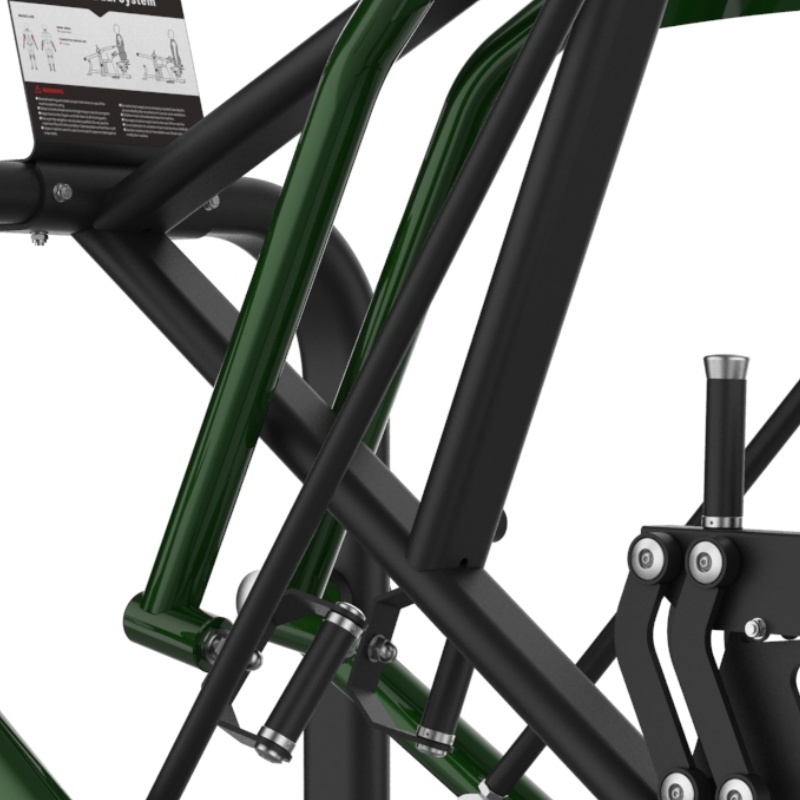
Additionally, selectorized machines intelligently optimize expensive floor space. You completely eliminate the dire need to store and manually load cumbersome weight plates. You do not need secondary plate trees cluttering up your workout area. This massive footprint reduction proves highly valuable. It greatly benefits both compact commercial facilities and premium home gym environments alike. You ultimately get a clean, highly efficient workout space dedicated purely to heavy lifting.
Investing in a combination leg machine requires careful, deliberate evaluation. You want equipment delivering both reliable safety and long-term biomechanical precision. Budget machines often feature poor structural geometry, slowly destroying your knees over time. Here is a definitive decision matrix to guide your hardware selection effectively.
Structural Integrity: Look actively for heavy-duty frames constructed from 11-gauge steel. Thick steel actively prevents annoying machine wobble during heavy eccentric loads. If the machine rocks side-to-side, your joints absorb that kinetic shock. Frame stability remains absolutely non-negotiable for lasting joint safety.
Ergonomic Adjustability: Human femur lengths vary drastically from person to person. The machine must feature micro-adjustments for the main backrest. It also heavily needs adjustable ankle rollers and padded thigh hold-downs. If you cannot secure your body perfectly, you will leverage your lower back to move the weight stack.
Transition Mechanics: Assess the exact speed of switching from an extension setup to a curl setup. You want to keep your heart rate up during workouts. Industry benchmarks utilize highly intuitive pull-pin mechanisms. For example, the OBS-BA Series Pin Loaded Machine allows you to seamlessly shift operational angles. You do not even require user dismount to change the primary machine settings.
Range of Motion (ROM): Ensure the internal cam design allows a full, deep stretch at the absolute bottom. It must also comfortably provide a peak muscle contraction at the very top. The machine should never prematurely bottom out during a full rep. Missing the bottom stretch effectively ruins the hypertrophy potential.
Proper machine calibration directly dictates your entire lifting success. Moving maximum weight means absolutely nothing if your physical setup is completely wrong. Misalignment causes immense sheer stress on the fragile patellar tendon. Over time, this poor setup leads directly to chronic knee pain.
Follow these standard operating procedures (SOPs) closely for flawless daily execution.
The Pivot Point Rule: Your actual knee joint must perfectly align with the machine's mechanical rotation axis. Find the prominent pivot point typically located on the side frame. Adjust the backrest forward or backward until your actual knee crease sits directly next to it.
Weight Selection Baseline: Do not ego-lift on joint isolation machines. We highly recommend starting at roughly 22% of your total body weight. Master the specific movement pattern carefully first. Once feeling comfortable, you can safely progress to heavy, failure-based sets.
Executing Extensions: Drive the padded ankle roller up using a fast, explosive concentric tempo. Do not forcefully lock out your knees at the very top of the movement. Keep a slight micro-bend to maintain tension. Release the weight down slowly using a controlled 3-second eccentric phase.
Executing Curls: Prone and seated variations require vastly different core stabilization techniques. When evaluating professional equipment like the OBS-BA31 Prone Leg Curl &Leg Extension Machine, proper technique remains paramount. Keep your hips firmly glued down to the bench during prone curls. This prevents your lower back from bridging up and compensating during the heavy lift.
You have the right machine and the correct physical setup. Now you desperately need a structured workout plan. Aimless lifting usually yields highly mediocre results. We strictly outline three evidence-based protocols to maximize leg shaping below.
The Pre-Exhaustion Protocol (Injury Prevention)
Perform 3 to 4 intense sets of machine extensions or curls prior to your squats. You actively pre-fatigue the target muscles very safely. This clever strategy allows you to reach true leg failure on compound lifts later. You will end up using significantly lighter, much safer weights on the main barbell. Your knees and spine will thank you immensely for this adjustment.
The Hypertrophy Protocol (Time Under Tension)
Focus heavily on a precise 1-0-3-0 lifting tempo. This means a 1-second explosive concentric drive upward. Take zero pause at the top peak. Perform a grueling 3-second eccentric descent downward. Take zero pause at the absolute bottom. Aim for 10 to 15 strict reps per set. This constant mechanical tension maximizes metabolic stress inside the muscle belly. This is where true tissue shaping actually occurs.
The Rehab & Stability Protocol
Utilize an extremely light weight stack setting. Ensure a meticulous, full range of motion every single time. Include rigid isometric holds for a full 2 seconds at the peak contraction point. Physical therapists use this exact methodology to rebuild tendon strength effectively post-injury.
Protocol Focus | Sets & Reps | Tempo Setup | Primary Benefit |
|---|---|---|---|
Pre-Exhaustion | 3-4 Sets, 12-15 Reps | Standard (2-0-2-0) | Injury prevention; safely limits barbell load later. |
Hypertrophy | 4 Sets, 10-15 Reps | Time Under Tension (1-0-3-0) | Maximizes metabolic stress and true muscle shaping. |
Rehab & Stability | 3 Sets, 15-20 Reps | Slow & Isometric (2-2-4-0) | Rebuilds connective tendon strength post-injury. |
Building well-defined legs requires much more than heavy squats alone. A dual-function leg extension and curl machine is certainly not a fitness gimmick. It is a biomechanically necessary tool for complete leg shaping. It guarantees proper rectus femoris development safely. It also readily allows you to accumulate safe training volume without destroying your lower back.
Here are your action-oriented next steps for better leg training:
Assess your current lower-body routine to identify specific muscular weaknesses immediately.
Incorporate targeted machine isolation to properly balance anterior and posterior leg strength.
Facility owners and serious home gym builders should prioritize high-grade pin-loaded equipment over flimsy budget alternatives.
Invest carefully in equipment offering optimal structural stability to ensure long-term joint health.
Taking these clear steps ensures maximum return on your floor space and your intense training effort.
A: No. Daily use severely overloads the delicate patellar tendon and knee connective tissues. You should treat them exactly like any other heavy hypertrophy movement. Always allow 48 to 72 hours of solid recovery between sessions to ensure proper muscle tissue repair and cleanly avoid overuse injuries.
A: It depends entirely on your individual muscular weaknesses. However, starting with leg curls can warm up the knee joint highly effectively. This provides a safe, stabilizing "cushion" of blood in the hamstrings before you move on to heavy quad extensions or standard barbell squats.
A: Yes, provided they feature adjustable pivot points and very rigid frames. High-tier dual machines offer the exact same biomechanical stimulus as bulky standalone units. They cleverly achieve this professional-grade isolation at a fraction of the square footage, making them ideal for superior spatial efficiency.


