
- All
- Product Name
- Product Keyword
- Product Model
- Product Summary
- Product Description
- Multi Field Search
Views: 0 Author: Site Editor Publish Time: 2025-12-27 Origin: Site


Investing in premium home gym equipment often feels like a numbers game: more horsepower, larger touchscreens, and smarter software usually justify a higher price tag. The Curved Treadmill presents a confusing paradox to the uninitiated. These machines typically cost more than standard commercial treadmills yet lack a motor, advanced incline settings, or integrated entertainment apps. For many decision-makers, paying a premium for a machine that forces you to do all the work seems counterintuitive.
However, the landscape of functional fitness has shifted. With the explosion of CrossFit, Hyrox, and data-driven rehabilitation, curved manual treadmills have graduated from niche athlete training centers to mainstream home gyms. They are no longer just tools for elite sprinters; they are viewed as long-term investments in biomechanics and durability.
This article moves beyond marketing hype to evaluate if these machines are truly effective. We will analyze the data regarding metabolic demand, examine how the concave design corrects running form, and calculate the long-term ownership value. The verdict is nuanced: while unmatched for interval training and gait correction, they may be counter-productive for specific marathon pacing strategies.
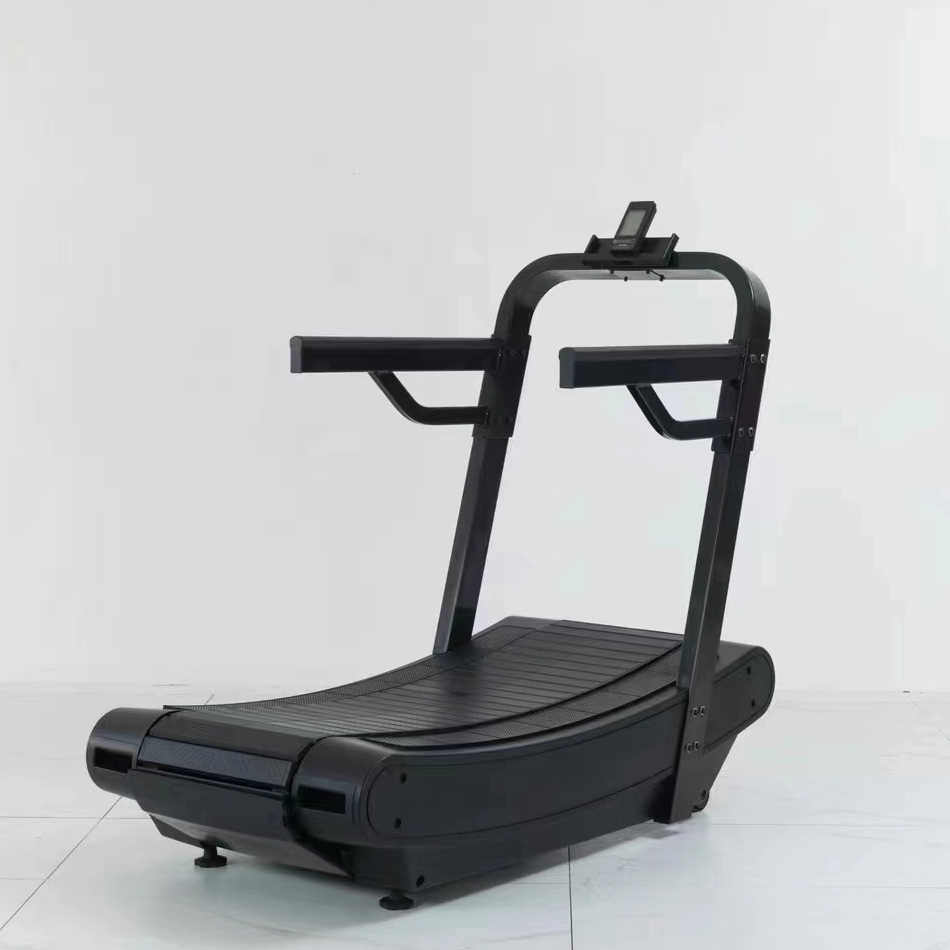
Metabolic Efficiency: Research indicates a 30% increase in energy expenditure compared to motorized treadmills, equating to a constant ~8% incline.
Form Correction: The concave design naturally enforces a midfoot/forefoot strike, reducing joint impact and improving posterior chain activation.
Durability & ROI: With no motor to burn out, the Total Cost of Ownership (TCO) is lower over 10+ years despite high upfront costs.
Usage Limitation: Not ideal for "Zone out" easy runs or precise steady-state pacing due to the high cognitive and physical demand required to move the belt.
To understand why curved treadmills are effective, you must first understand the physics of resistance. On a standard motorized treadmill, the belt moves at a set speed. Your job is simply to lift your foot and place it down again to keep up. The machine does a significant portion of the work by pulling your leg back.
A curved manual treadmill operates on friction and gravity. The belt has inertia. To move it, you must engage your muscles to overcome that static weight. Every single step becomes a propulsive action. You are not just keeping up with a belt; you are driving it backward with every stride. This fundamental shift in mechanics changes the metabolic equation entirely.
Scientific analysis backs up the "feeling" of difficulty. The University of Essex conducted a pivotal study comparing physiological responses between motorized and non-motorized curved running. The data produced a "30% harder" rule of thumb that is widely cited in the fitness industry.
The study found that at equivalent speeds, runners exhibited significantly higher outputs on the curve:
Heart Rate: Approximately 16% higher than on a flat, motorized belt.
Oxygen Consumption (VO2): Drastically increased, indicating a higher aerobic demand.
Perceived Exertion: Runners felt they were working much harder to maintain the same pace.
If your primary goal is time-efficient fat loss, this data confirms the machine's effectiveness. You can achieve the same metabolic output in a 20-minute session on a curve that might take 30 or 40 minutes on a standard deck.
Users often describe the experience of running on a curve as a "permanent uphill battle." This is not an exaggeration. The resistance generated by the belt geometry creates a physiological demand roughly equivalent to running on an 8% incline. This makes the machine an incredible tool for building work capacity, but it also means "easy" runs are rarely easy.
Because the intensity is inherently higher, training volume must be managed carefully. If you transition from a motorized treadmill to a curved model, you cannot simply replicate your weekly mileage immediately. Experts recommend adjusting volume downward by approximately 20% during the initial adaptation phase. Ignoring this adjustment can lead to rapid burnout or overtraining, as your central nervous system adapts to the increased load.
Beyond calorie burning, the most compelling argument for the Curved Treadmill is its ability to act as a biomechanical teacher. Many recreational runners suffer from poor form, characterized by overstriding (landing with the foot far in front of the hip) and heavy heel striking. This braking force sends shockwaves up the shin and into the knee.
The concave shape of the running surface makes heel striking mechanically difficult and physically uncomfortable. To keep the belt moving smoothly, you must strike near the bottom of the arc. This naturally positions the foot directly under the body’s center of mass.
This process is known as "Gait Retraining." Unlike verbal coaching cues which you might forget as you get tired, the machine provides immediate physical feedback. If you overstride, the belt slows down or feels clunky. To maintain speed, you instinctively switch to a midfoot or forefoot strike, which utilizes the foot's natural arch as a shock absorber.
Muscle activation patterns differ significantly between machine types. Motorized belts facilitate "quad dominance" because the motor pulls the leg through the extension phase. Conversely, a manual belt requires you to actively pull the tread backward. This engages the posterior chain—specifically the glutes and hamstrings—much more aggressively.
| Feature | Motorized Treadmill | Curved Manual Treadmill |
|---|---|---|
| Primary Muscle Driver | Quads / Hip Flexors | Glutes / Hamstrings (Posterior Chain) |
| Foot Strike | Allows Heel Striking | Encourages Midfoot/Forefoot Strike |
| Propulsion | Motor moves belt | User drives belt |
| Core Engagement | Low to Moderate | High (Required for stability) |
Safety and impact reduction are critical for longevity. Most high-end curved units use a slatted belt design made of rubber or composite materials, rather than the thin continuous belt found on standard machines. These slats offer superior shock absorption.
Furthermore, NCBI data suggests that running on a curved non-motorized treadmill naturally reduces step length. A shorter stride length correlates with lower impact forces on the knees and hips. For rehabilitation, this is a game-changer. The machine stops when you stop, providing immediate safety for seniors or those recovering from injury. It also supports backward walking effectively, a proven method for strengthening the vastus medialis and protecting the knee joint.
The upfront cost of a manual treadmill can be shocking, often ranging from $3,000 to over $6,000 for commercial-grade units. However, when evaluating the Total Cost of Ownership (TCO) over a decade, the math shifts in favor of the curve.
The motor and its associated controller board are the most common failure points in home fitness equipment. They are susceptible to burnout, require calibration, and eventually need replacement. By eliminating the motor, you eliminate the primary source of maintenance headaches.
Durability is another factor. Standard treadmill belts are often rated for 15,000 to 20,000 miles. In contrast, the heavy-duty slat belts on premium manual treadmills are frequently rated for 150,000+ miles. For a home user, this is effectively a "forever" machine.
Maintenance on a manual unit is incredibly low. It typically involves vacuuming the gaps between slats and occasionally checking the bearings. There is no deck to wax, no belt to align electronically, and no motor brushes to replace. Additionally, these machines consume zero electricity, offering a small but consistent saving on utility bills and reducing your carbon footprint.
Not everyone has the space or budget for a full-commercial footprint. This has led to the rise of the Mini Curved Treadmill category. These compact versions offer the same fundamental mechanics—user-powered resistance and gait correction—in a smaller package.
There is a trade-off to consider with mini versions. While they save floor space and money, they sometimes feature a steeper curve or a shorter runway. This makes them excellent for walking, jogging, and moderate intervals, but they may be challenging for tall users attempting maximum-effort sprinting. However, for the average home gym owner focused on metabolic conditioning or steady walks, a mini unit provides the vast majority of the benefits at a fraction of the footprint.
Despite the benefits, these machines are not a universal solution. There are specific training scenarios where a curved treadmill is less effective than a motorized alternative.
If your training requires holding a precise pace—for example, a 9:00/mile marathon pace for 90 minutes—a manual treadmill is frustrating. You will experience "drift." As you fatigue, the belt slows down immediately. Conversely, if you lose focus, you might instinctively speed up. Maintaining a lock-step steady pace requires immense cognitive focus, which can detract from the "zone out" meditative state many runners enjoy.
Zone 2 training (low heart rate, aerobic base building) is difficult for beginners on a curve. The minimum physical effort required simply to get the heavy belt moving often spikes the heart rate immediately into Zone 3 or 4. Walking or jogging efficiently enough to keep the heart rate low requires a steep learning curve and significant core strength.
While there is no motor hum, these machines are not silent. The mechanical movement of the slats creates a distinct "clacking" or "rumbling" noise, especially at high speeds. It is generally louder than the whir of a quality motorized belt. If you live in an apartment with thin floors, the vibration from the heavy foot strikes required to drive the belt might disturb neighbors downstairs.
If you rely on Zwift, Peloton, or iFit for motivation, the integration on manual treadmills is often clunky. Most consoles are basic, displaying LCD metrics like speed, time, watts, and calories. They lack immersive HD touchscreens. While some users attach foot pods to connect to virtual running worlds, it is rarely a seamless plug-and-play experience compared to smart treadmills.
Is a curved treadmill effective for you? It depends entirely on your athletic profile and goals.
Verdict: Highly Effective.
For High-Intensity Interval Training (HIIT), nothing compares. You can accelerate from a standstill to a full sprint in three strides, and decelerate just as fast. Motorized decks lag significantly during these transitions, making them dangerous or ineffective for true sprint work.
Verdict: Supplemental Tool Only.
This should likely not be your only running machine. It is excellent for strength days, tempo runs, and fixing your form. However, replacing 100% of your road or flat-belt mileage with curved running alters your fatigue patterns too drastically. It works best as a secondary tool to build power and resilience.
Verdict: Effective but requires coaching.
The safety profile is high because the user controls the speed completely. However, deconditioned users may find the initial effort to move the belt tiring. With proper coaching on posture, it becomes a powerful tool for rebuilding posterior chain strength without joint impact.
Verdict: Situational.
If you have a small apartment and primarily want to walk or jog for health, a Mini Curved Treadmill is a smart buy. It forces better posture than a cheap foldable motorized pad. Just be aware of the stride limitations if you plan to incorporate high-speed sprinting later.
Are curved treadmills effective? The answer is a resounding yes, provided you understand they are conditioning tools rather than traditional "cruising" machines. They deliver a higher return on investment regarding time spent exercising; you burn more calories, activate more muscle, and correct your biomechanics in less time than on a standard deck.
If you value durability, want to improve your running mechanics, and focus on intervals or HIIT, the Curved Treadmill is a "buy it for life" investment that outperforms motorized options. However, if you require precise pacing control for long-distance training or rely on entertainment screens to stay motivated, a standard motorized treadmill remains the superior choice.
A: Yes, you can walk on it, and it provides a superior workout compared to flat walking. Because you must actively push the belt, walking engages your core, hamstrings, and glutes more intensely. However, it requires better balance and focus than a motorized treadmill, so new users should start holding the handrails until they get used to the movement.
A: The cost is driven by hardware quality rather than electronics. They utilize heavy-duty slat belt technology, precision ball bearings, and commercial-grade steel frames designed to handle intense friction and weight. Unlike cheap motorized treadmills built with plastic parts and thin belts, these are constructed to last decades with minimal maintenance.
A: Generally, it is better for your knees. The concave design encourages you to land on the ball of your foot (midfoot) rather than your heel. This alignment allows your muscles to absorb the shock rather than your joints. Additionally, the slatted surface usually offers better shock absorption than a standard treadmill deck.
A: They are highly effective for walking, jogging, and moderate running. However, the shorter belt length limits stride capability. Tall users (over 6'0") or athletes wanting to perform max-effort sprints may run out of room on a mini version. For general fitness and space-saving needs, they are excellent.
A: Most users adapt to the balance and movement within 3 to 5 sessions. The initial feeling of falling forward usually dissipates quickly. However, learning to maintain a slow, steady pace without fluctuating speed can take longer to master and requires core strength and focus.


